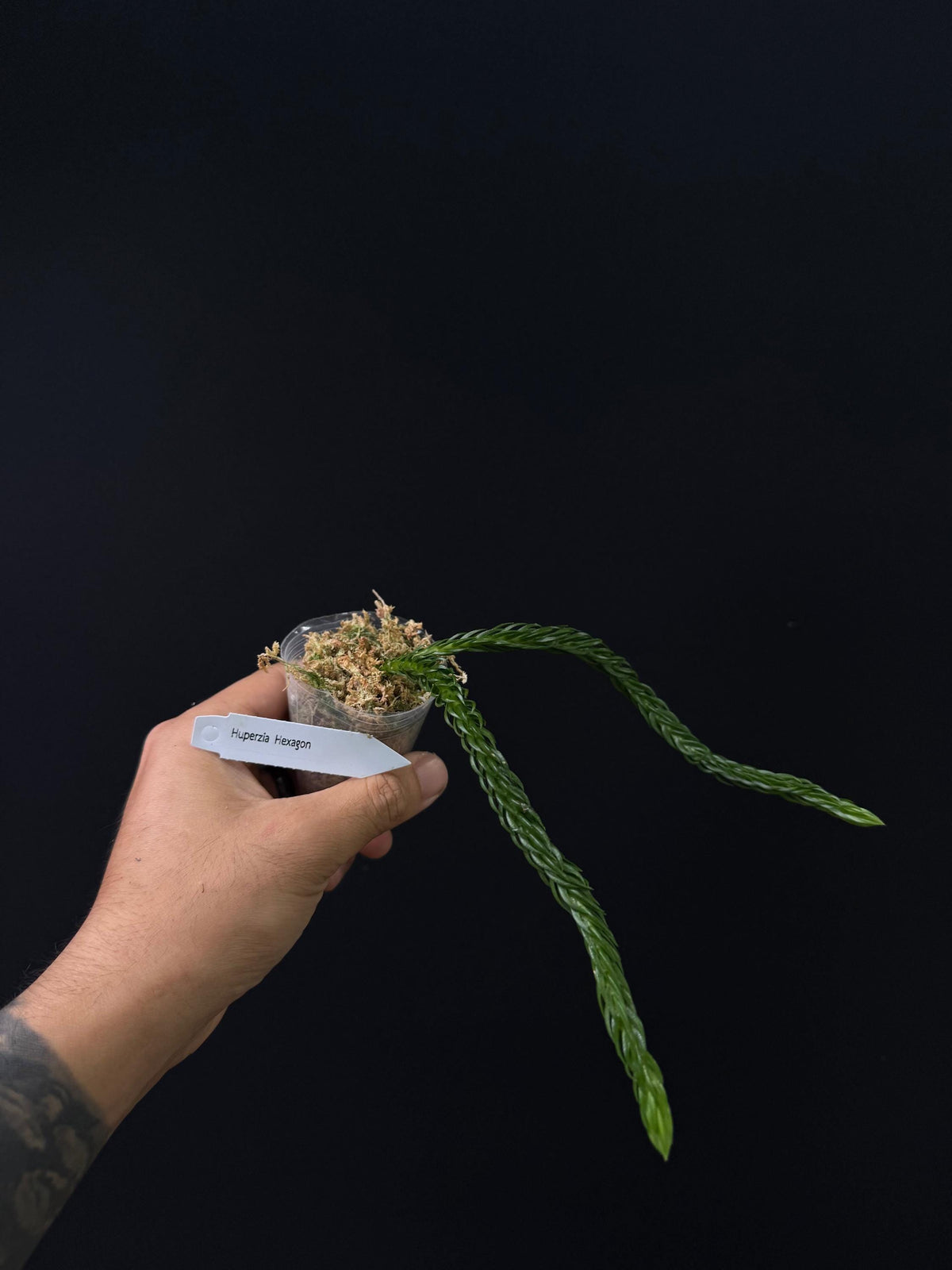
Huperzia hexagon
Huperzia sp. ‘Hexagon’
Huperzia sp. ‘Hexagon’ is an unusual tassel fern ally prized for its tightly arranged, glossy foliage and distinctive geometric stem shape. Its pointed leaves overlap in a spiraling pattern around the stems, creating the impression of a hexagonal cross section when viewed from the end. The foliage has a smooth, slightly waxy texture that gives the plant a particularly clean and structured appearance.
‘Hexagon’ is currently sold under a horticultural name rather than a confirmed species identification, so Huperzia sp. ‘Hexagon’ is the most accurate way to label it.
Foliage
The foliage is the defining feature of this Huperzia.
Each stem is densely covered in pointed leaves that overlap one another in a regular spiral. Rather than producing the softer or more feathery appearance seen in some Huperzia, ‘Hexagon’ develops a firm, organized structure with pronounced angles along the stem.
The leaves are glossy green with a smooth, somewhat waxy surface.
As the stems lengthen, the geometric pattern becomes increasingly noticeable.
Growth Habit
Huperzia ‘Hexagon’ develops long cascading stems that are best allowed to hang naturally.
Young plants initially remain relatively compact, but established specimens can develop increasingly long stems with additional branching.
Because the foliage surrounds the stems on all sides, hanging the plant allows its distinctive structure to remain visible.
It works especially well in hanging baskets, mounted arrangements, or elevated pots where the stems can grow downward without resting against a surface.
Light
Provide bright indirect to filtered light.
Huperzia generally do not require extremely intense light. Bright shade or filtered greenhouse conditions work very well.
Suitable conditions include:
Bright indirect indoor light
Filtered greenhouse light
Bright outdoor shade
Gentle early morning sun
Avoid prolonged harsh afternoon sun, which can bleach or scorch the foliage.
Water
Keep the root zone consistently moist but airy.
Water thoroughly and allow the growing media to begin approaching dryness before watering again.
Unlike plants that prefer a pronounced dry period, Huperzia generally perform better when they are not allowed to remain completely dry for extended periods.
At the same time, avoid keeping the roots permanently saturated.
The goal is even moisture with plenty of oxygen around the root system.
Humidity
Approximately 60–80% humidity provides excellent growing conditions.
‘Hexagon’ has relatively smooth, waxy foliage, which may allow it to tolerate fluctuations in humidity somewhat better than more delicate Huperzia types.
Higher humidity encourages lush growth, but adequate airflow is equally important.
Established plants can often adapt to moderate household humidity when their root zone remains properly hydrated.
Airflow
Provide consistent gentle airflow.
Huperzia appreciate humidity but do not benefit from stagnant, constantly wet conditions.
Air movement helps prevent moisture from remaining trapped around the crown and allows the growing media to breathe between waterings.
This becomes especially important when growing the plant in sphagnum moss.
Temperature
Ideal temperatures are approximately 65–82°F.
Warm, stable conditions encourage active growth.
Protect from temperatures below approximately 55°F for extended periods.
Avoid frost and freezing temperatures.
During cooler conditions, reduce watering frequency slightly because the growing media will dry more slowly.
Growing Media
Huperzia ‘Hexagon’ performs well in a loose, moisture-retentive epiphytic mix.
Good options include:
Long-fiber sphagnum moss
Sphagnum mixed with fine orchid bark
Fine bark with perlite and sphagnum
An airy epiphytic fern mixture
The growing media should retain moisture while still allowing excellent airflow around the roots.
Avoid dense standard potting soil that remains waterlogged.
Potting and Mounting
‘Hexagon’ can be grown in hanging baskets, pots, or mounted arrangements.
Hanging baskets work particularly well because they allow the stems to cascade freely.
When growing in sphagnum, avoid packing the moss extremely tightly around the roots.
Mounted plants generally dry faster than potted plants and may require more frequent watering.
Plastic pots or baskets can help retain moisture longer in environments with lower humidity.
Growth Rate
Growth is steady under warm, humid conditions.
New stems emerge from the crown and gradually elongate before developing additional branching.
Huperzia can appear slow while establishing a new root system, but established plants can eventually develop substantial hanging growth.
Avoid repeatedly disturbing or repotting the plant once it has begun establishing.
Feeding
Feed lightly during active growth.
A balanced fertilizer diluted to approximately ¼ strength can be applied periodically during watering.
Huperzia have relatively fine root systems and generally respond better to light, consistent feeding than strong fertilizer applications.
Flush the growing media occasionally with plain water to prevent fertilizer salts from accumulating.
Water Quality
Rainwater, distilled water, or low-mineral water is ideal when available.
Huperzia can be sensitive to excessive mineral and fertilizer buildup over time, particularly when grown in sphagnum.
If using tap water, occasionally flush the growing media thoroughly.
Propagation
Huperzia reproduce naturally through spores and can also sometimes be propagated from established vegetative growth.
Spore propagation is slow and requires consistently humid conditions.
For most growers, allowing the plant to mature naturally into a larger hanging specimen is the simplest approach.
Best Growing Conditions
Bright indirect or filtered light
60–80% humidity
65–82°F temperatures
Consistent gentle airflow
Even moisture without waterlogged roots
Loose sphagnum or airy epiphytic media
Hanging position for natural cascading growth
Light fertilizer during active growth
Additional Notes
The name ‘Hexagon’ comes directly from the unusual arrangement of its foliage. The overlapping leaves create distinct angles around the stem, giving it an almost geometric appearance that becomes more obvious as the stems mature.
Because the exact species has not been firmly identified, keeping the plant labeled Huperzia sp. ‘Hexagon’ avoids assigning it an incorrect botanical species name.
Allow the stems plenty of room to hang freely. As the plant matures and branches, the cascading growth highlights the dense, angular foliage that makes ‘Hexagon’ so distinctive.
-------
⚠️ Important Shipping Notes
We take great care to ensure your plant arrives safely:
• We ship every Monday and Tuesday to minimize weekend delays.
• We check destination weather on Sunday night and will add free insulation and heat packs when needed for safe delivery.
• If a plant arrives damaged, buyers must provide an unboxing video within one hour of delivery.
(We cannot be responsible for plants left outside, delayed opening, or packages exposed to heat/cold.)
🌟 Perfect For:
• Rare plant collectors
• Fans of unusual foliage
• Terrarium or greenhouse keepers
• Anyone building a unique indoor jungle
Exported By ExportYourStore
Listed with ExportYourStore.com
Huperzia sp. ‘Hexagon’ is an unusual tassel fern ally prized for its tightly arranged, glossy foliage and distinctive geometric stem shape. Its pointed leaves overlap in a spiraling pattern around the stems, creating the impression of a hexagonal cross section when viewed from the end. The foliage has a smooth, slightly waxy texture that gives the plant a particularly clean and structured appearance.
‘Hexagon’ is currently sold under a horticultural name rather than a confirmed species identification, so Huperzia sp. ‘Hexagon’ is the most accurate way to label it.
Foliage
The foliage is the defining feature of this Huperzia.
Each stem is densely covered in pointed leaves that overlap one another in a regular spiral. Rather than producing the softer or more feathery appearance seen in some Huperzia, ‘Hexagon’ develops a firm, organized structure with pronounced angles along the stem.
The leaves are glossy green with a smooth, somewhat waxy surface.
As the stems lengthen, the geometric pattern becomes increasingly noticeable.
Growth Habit
Huperzia ‘Hexagon’ develops long cascading stems that are best allowed to hang naturally.
Young plants initially remain relatively compact, but established specimens can develop increasingly long stems with additional branching.
Because the foliage surrounds the stems on all sides, hanging the plant allows its distinctive structure to remain visible.
It works especially well in hanging baskets, mounted arrangements, or elevated pots where the stems can grow downward without resting against a surface.
Light
Provide bright indirect to filtered light.
Huperzia generally do not require extremely intense light. Bright shade or filtered greenhouse conditions work very well.
Suitable conditions include:
Bright indirect indoor light
Filtered greenhouse light
Bright outdoor shade
Gentle early morning sun
Avoid prolonged harsh afternoon sun, which can bleach or scorch the foliage.
Water
Keep the root zone consistently moist but airy.
Water thoroughly and allow the growing media to begin approaching dryness before watering again.
Unlike plants that prefer a pronounced dry period, Huperzia generally perform better when they are not allowed to remain completely dry for extended periods.
At the same time, avoid keeping the roots permanently saturated.
The goal is even moisture with plenty of oxygen around the root system.
Humidity
Approximately 60–80% humidity provides excellent growing conditions.
‘Hexagon’ has relatively smooth, waxy foliage, which may allow it to tolerate fluctuations in humidity somewhat better than more delicate Huperzia types.
Higher humidity encourages lush growth, but adequate airflow is equally important.
Established plants can often adapt to moderate household humidity when their root zone remains properly hydrated.
Airflow
Provide consistent gentle airflow.
Huperzia appreciate humidity but do not benefit from stagnant, constantly wet conditions.
Air movement helps prevent moisture from remaining trapped around the crown and allows the growing media to breathe between waterings.
This becomes especially important when growing the plant in sphagnum moss.
Temperature
Ideal temperatures are approximately 65–82°F.
Warm, stable conditions encourage active growth.
Protect from temperatures below approximately 55°F for extended periods.
Avoid frost and freezing temperatures.
During cooler conditions, reduce watering frequency slightly because the growing media will dry more slowly.
Growing Media
Huperzia ‘Hexagon’ performs well in a loose, moisture-retentive epiphytic mix.
Good options include:
Long-fiber sphagnum moss
Sphagnum mixed with fine orchid bark
Fine bark with perlite and sphagnum
An airy epiphytic fern mixture
The growing media should retain moisture while still allowing excellent airflow around the roots.
Avoid dense standard potting soil that remains waterlogged.
Potting and Mounting
‘Hexagon’ can be grown in hanging baskets, pots, or mounted arrangements.
Hanging baskets work particularly well because they allow the stems to cascade freely.
When growing in sphagnum, avoid packing the moss extremely tightly around the roots.
Mounted plants generally dry faster than potted plants and may require more frequent watering.
Plastic pots or baskets can help retain moisture longer in environments with lower humidity.
Growth Rate
Growth is steady under warm, humid conditions.
New stems emerge from the crown and gradually elongate before developing additional branching.
Huperzia can appear slow while establishing a new root system, but established plants can eventually develop substantial hanging growth.
Avoid repeatedly disturbing or repotting the plant once it has begun establishing.
Feeding
Feed lightly during active growth.
A balanced fertilizer diluted to approximately ¼ strength can be applied periodically during watering.
Huperzia have relatively fine root systems and generally respond better to light, consistent feeding than strong fertilizer applications.
Flush the growing media occasionally with plain water to prevent fertilizer salts from accumulating.
Water Quality
Rainwater, distilled water, or low-mineral water is ideal when available.
Huperzia can be sensitive to excessive mineral and fertilizer buildup over time, particularly when grown in sphagnum.
If using tap water, occasionally flush the growing media thoroughly.
Propagation
Huperzia reproduce naturally through spores and can also sometimes be propagated from established vegetative growth.
Spore propagation is slow and requires consistently humid conditions.
For most growers, allowing the plant to mature naturally into a larger hanging specimen is the simplest approach.
Best Growing Conditions
Bright indirect or filtered light
60–80% humidity
65–82°F temperatures
Consistent gentle airflow
Even moisture without waterlogged roots
Loose sphagnum or airy epiphytic media
Hanging position for natural cascading growth
Light fertilizer during active growth
Additional Notes
The name ‘Hexagon’ comes directly from the unusual arrangement of its foliage. The overlapping leaves create distinct angles around the stem, giving it an almost geometric appearance that becomes more obvious as the stems mature.
Because the exact species has not been firmly identified, keeping the plant labeled Huperzia sp. ‘Hexagon’ avoids assigning it an incorrect botanical species name.
Allow the stems plenty of room to hang freely. As the plant matures and branches, the cascading growth highlights the dense, angular foliage that makes ‘Hexagon’ so distinctive.
-------
⚠️ Important Shipping Notes
We take great care to ensure your plant arrives safely:
• We ship every Monday and Tuesday to minimize weekend delays.
• We check destination weather on Sunday night and will add free insulation and heat packs when needed for safe delivery.
• If a plant arrives damaged, buyers must provide an unboxing video within one hour of delivery.
(We cannot be responsible for plants left outside, delayed opening, or packages exposed to heat/cold.)
🌟 Perfect For:
• Rare plant collectors
• Fans of unusual foliage
• Terrarium or greenhouse keepers
• Anyone building a unique indoor jungle
Exported By ExportYourStore
Listed with ExportYourStore.com
Huperzia hexagon
Sale price$79.00
Regular price (/)