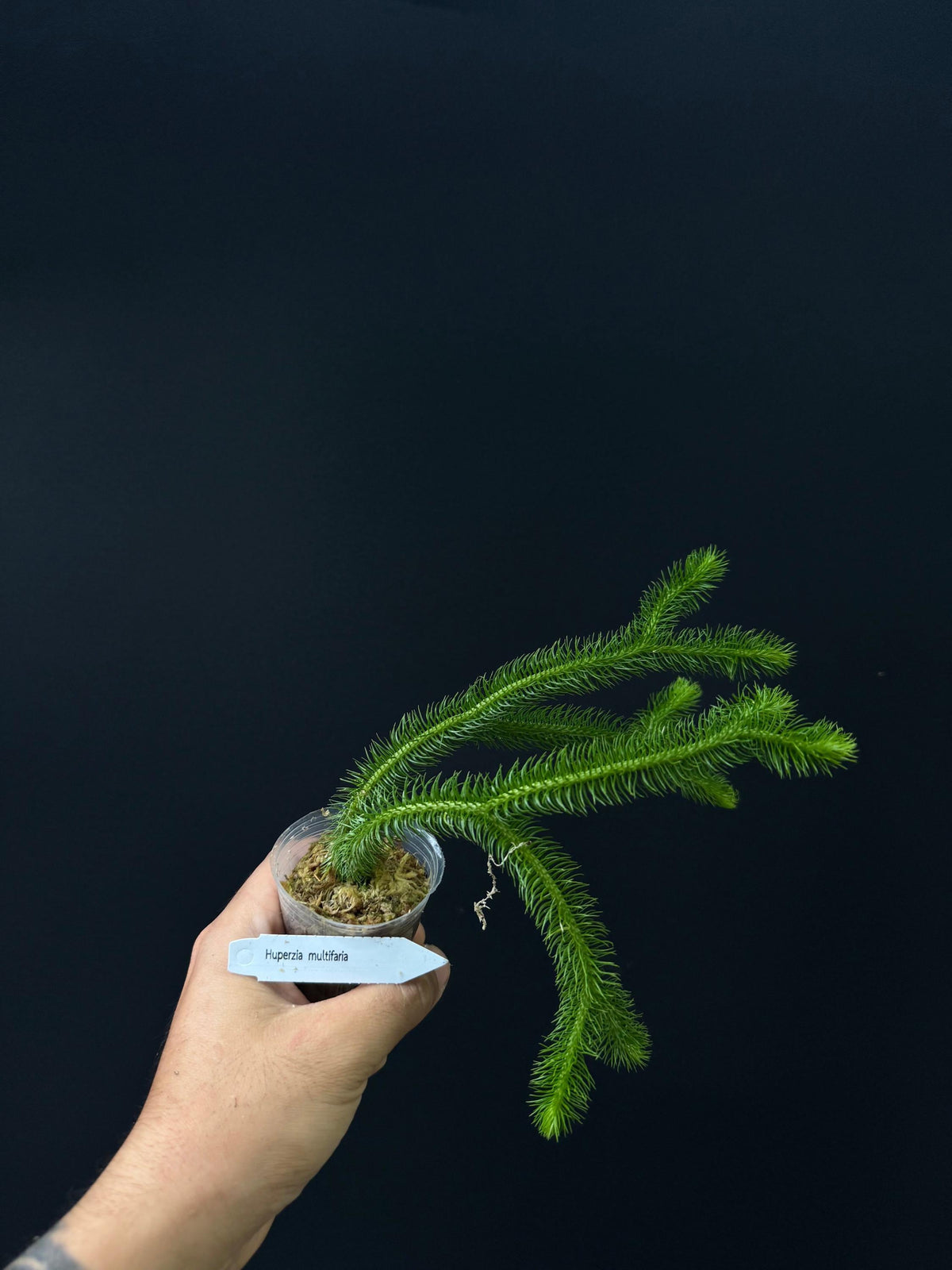
Huperzia multifaria
Huperzia multifaria
Huperzia multifaria is a tropical epiphytic clubmoss with long cascading stems and densely arranged foliage that gives mature plants a full, textured appearance. Native populations are documented from the Moluccas of Indonesia, with records also reported from the Philippines and New Guinea region.
Under a newer classification, the species is also recognized as Phlegmariurus multifarius (Alderw.) A.R.Field Bostock. Huperzia multifaria remains a widely recognizable horticultural name, while Phlegmariurus multifarius reflects the modern separation of many tropical epiphytic Huperzia into Phlegmariurus.
Foliage
Huperzia multifaria produces densely arranged leaves along elongated stems, creating a thick, almost rope-like appearance.
The foliage remains relatively uniform around the stem rather than lying completely flat, which gives each branch noticeable dimension when viewed from different angles.
As the stems mature, the dense arrangement of foliage becomes increasingly pronounced and creates the characteristic tassel-like appearance associated with tropical Huperzia.
New growth generally emerges lighter green before gradually deepening in color.
Growth Habit
This species has a naturally epiphytic growth habit and is especially well suited to hanging culture. Botanical records specifically recognize Phlegmariurus multifarius as an epiphytic herb.
Young plants begin with relatively short upright or arching growth, but the stems gradually become pendulous as they gain length.
Established plants can develop multiple branching stems that cascade downward from the crown.
Allowing the stems to hang freely produces the most natural mature form and prevents the foliage from becoming distorted against shelves or surrounding plants.
Light
Provide bright indirect or filtered light.
Huperzia multifaria appreciates enough light to maintain compact, dense foliage without being exposed to intense direct sun.
Filtered greenhouse light, bright indoor indirect light, bright shade outdoors, or gentle early morning sun can all work well.
Avoid prolonged harsh afternoon sun.
Too much direct light can cause bleaching, yellowing, or crispy foliage, while excessively low light can produce weaker and more elongated growth.
Water
Keep the root system evenly moist while still allowing plenty of air around the roots.
Water thoroughly whenever the growing media begins approaching dryness.
Huperzia multifaria should not be treated like a succulent or allowed to remain completely dry for extended periods.
At the same time, constantly saturated media can reduce oxygen around the roots and eventually cause decline.
The goal is:
Thorough watering
Consistent moisture
Excellent drainage
Good airflow around the roots
Mounted plants generally require more frequent watering than plants grown in baskets or pots.
Humidity
Approximately 65–85% humidity is ideal.
As a tropical epiphyte, Huperzia multifaria responds particularly well to consistently humid conditions.
Higher humidity helps developing stems remain lush and reduces premature drying of the foliage.
Established plants may tolerate somewhat lower humidity when watering is consistent, but very dry air can cause browning at the foliage tips and slower growth.
Humidity should always be paired with airflow rather than stagnant conditions.
Airflow
Provide gentle but consistent airflow.
Air movement is especially important when growing Huperzia in high humidity because it allows excess moisture to evaporate from the foliage and growing media.
The ideal environment combines humid air with an open, breathable root system.
Avoid placing the plant where wet foliage and saturated moss remain stagnant for long periods.
Temperature
Ideal temperatures are approximately 65–82°F.
Warm temperatures encourage active root and stem growth.
Protect the plant from prolonged temperatures below approximately 55°F.
Avoid frost and freezing conditions entirely.
Growth may slow during cooler periods, so watering and fertilizer should be reduced accordingly.
Growing Media
Use a loose, airy epiphytic mixture that retains moisture without becoming compacted.
Long-fiber sphagnum moss works especially well.
Other suitable mixes can include sphagnum combined with fine orchid bark, perlite, or other coarse materials that increase airflow.
Avoid dense traditional potting soil.
The root system should remain moist but should always have access to oxygen.
When using sphagnum, pack it loosely rather than compressing it tightly around the roots.
Potting and Mounting
Huperzia multifaria is especially attractive in a hanging basket because its stems naturally cascade downward as they mature.
It can also be mounted onto cork, tree fern fiber, wood, or another moisture-resistant surface using sphagnum around the roots.
Mounted plants create a very natural presentation but dry considerably faster and require closer attention to watering.
Hanging baskets retain moisture longer and are often easier to maintain while still allowing the stems to develop naturally.
Leave plenty of open space beneath the plant.
Established stems can become increasingly long and should not be repeatedly moved or bent once they have hardened.
Growth
Growth is generally steady under warm, humid conditions.
New stems emerge from the crown and gradually elongate before branching.
A young plant may spend considerable time establishing its root system before producing noticeably faster stem growth.
Once established, multiple hanging stems can gradually create a large, dense specimen.
Avoid unnecessary repotting or disturbance of the root system.
Feeding
Feed lightly during periods of active growth.
A balanced fertilizer diluted to approximately ¼ strength can be used periodically during watering.
Huperzia generally respond better to frequent light feeding than concentrated fertilizer.
Avoid allowing fertilizer salts to accumulate in sphagnum or other moisture-retentive media.
Occasionally watering thoroughly with plain water helps flush excess minerals from the root zone.
Reduce fertilizer whenever temperatures cool or active growth slows.
Water Quality
Rainwater, distilled water, reverse-osmosis water, or other low-mineral water is ideal when available.
This is especially helpful when the plant is grown in sphagnum moss because minerals can gradually accumulate as water evaporates.
If using tap water, periodically flush the growing media thoroughly to prevent buildup.
Spores
Like other Huperzia and Phlegmariurus, this species does not produce flowers or seeds.
Instead, mature growth produces spores.
Spore-bearing portions may develop differently in shape or foliage density from younger vegetative stems.
This change is a normal part of the plants reproductive cycle.
Best Growing Conditions
Bright filtered light
65–85% humidity
65–82°F temperatures
Consistent gentle airflow
Even moisture without saturated roots
Loose sphagnum or another airy epiphytic medium
Hanging placement with room for cascading stems
Light fertilizer during active growth
Additional Notes
Huperzia multifaria was originally described as Lycopodium multifarium in 1922. It was later transferred to Huperzia and then recombined as Phlegmariurus multifarius in 2013.
Its natural epiphytic habit makes it especially well suited to hanging culture, where the stems can develop without obstruction.
Once established, the combination of densely packed foliage, branching stems, and long cascading growth gives Huperzia multifaria an impressive mature form that becomes increasingly dramatic with age.
-------
⚠️ Important Shipping Notes
We take great care to ensure your plant arrives safely:
• We ship every Monday and Tuesday to minimize weekend delays.
• We check destination weather on Sunday night and will add free insulation and heat packs when needed for safe delivery.
• If a plant arrives damaged, buyers must provide an unboxing video within one hour of delivery.
(We cannot be responsible for plants left outside, delayed opening, or packages exposed to heat/cold.)
🌟 Perfect For:
• Rare plant collectors
• Fans of unusual foliage
• Terrarium or greenhouse keepers
• Anyone building a unique indoor jungle
Exported By ExportYourStore
Listed with ExportYourStore.com
Huperzia multifaria is a tropical epiphytic clubmoss with long cascading stems and densely arranged foliage that gives mature plants a full, textured appearance. Native populations are documented from the Moluccas of Indonesia, with records also reported from the Philippines and New Guinea region.
Under a newer classification, the species is also recognized as Phlegmariurus multifarius (Alderw.) A.R.Field Bostock. Huperzia multifaria remains a widely recognizable horticultural name, while Phlegmariurus multifarius reflects the modern separation of many tropical epiphytic Huperzia into Phlegmariurus.
Foliage
Huperzia multifaria produces densely arranged leaves along elongated stems, creating a thick, almost rope-like appearance.
The foliage remains relatively uniform around the stem rather than lying completely flat, which gives each branch noticeable dimension when viewed from different angles.
As the stems mature, the dense arrangement of foliage becomes increasingly pronounced and creates the characteristic tassel-like appearance associated with tropical Huperzia.
New growth generally emerges lighter green before gradually deepening in color.
Growth Habit
This species has a naturally epiphytic growth habit and is especially well suited to hanging culture. Botanical records specifically recognize Phlegmariurus multifarius as an epiphytic herb.
Young plants begin with relatively short upright or arching growth, but the stems gradually become pendulous as they gain length.
Established plants can develop multiple branching stems that cascade downward from the crown.
Allowing the stems to hang freely produces the most natural mature form and prevents the foliage from becoming distorted against shelves or surrounding plants.
Light
Provide bright indirect or filtered light.
Huperzia multifaria appreciates enough light to maintain compact, dense foliage without being exposed to intense direct sun.
Filtered greenhouse light, bright indoor indirect light, bright shade outdoors, or gentle early morning sun can all work well.
Avoid prolonged harsh afternoon sun.
Too much direct light can cause bleaching, yellowing, or crispy foliage, while excessively low light can produce weaker and more elongated growth.
Water
Keep the root system evenly moist while still allowing plenty of air around the roots.
Water thoroughly whenever the growing media begins approaching dryness.
Huperzia multifaria should not be treated like a succulent or allowed to remain completely dry for extended periods.
At the same time, constantly saturated media can reduce oxygen around the roots and eventually cause decline.
The goal is:
Thorough watering
Consistent moisture
Excellent drainage
Good airflow around the roots
Mounted plants generally require more frequent watering than plants grown in baskets or pots.
Humidity
Approximately 65–85% humidity is ideal.
As a tropical epiphyte, Huperzia multifaria responds particularly well to consistently humid conditions.
Higher humidity helps developing stems remain lush and reduces premature drying of the foliage.
Established plants may tolerate somewhat lower humidity when watering is consistent, but very dry air can cause browning at the foliage tips and slower growth.
Humidity should always be paired with airflow rather than stagnant conditions.
Airflow
Provide gentle but consistent airflow.
Air movement is especially important when growing Huperzia in high humidity because it allows excess moisture to evaporate from the foliage and growing media.
The ideal environment combines humid air with an open, breathable root system.
Avoid placing the plant where wet foliage and saturated moss remain stagnant for long periods.
Temperature
Ideal temperatures are approximately 65–82°F.
Warm temperatures encourage active root and stem growth.
Protect the plant from prolonged temperatures below approximately 55°F.
Avoid frost and freezing conditions entirely.
Growth may slow during cooler periods, so watering and fertilizer should be reduced accordingly.
Growing Media
Use a loose, airy epiphytic mixture that retains moisture without becoming compacted.
Long-fiber sphagnum moss works especially well.
Other suitable mixes can include sphagnum combined with fine orchid bark, perlite, or other coarse materials that increase airflow.
Avoid dense traditional potting soil.
The root system should remain moist but should always have access to oxygen.
When using sphagnum, pack it loosely rather than compressing it tightly around the roots.
Potting and Mounting
Huperzia multifaria is especially attractive in a hanging basket because its stems naturally cascade downward as they mature.
It can also be mounted onto cork, tree fern fiber, wood, or another moisture-resistant surface using sphagnum around the roots.
Mounted plants create a very natural presentation but dry considerably faster and require closer attention to watering.
Hanging baskets retain moisture longer and are often easier to maintain while still allowing the stems to develop naturally.
Leave plenty of open space beneath the plant.
Established stems can become increasingly long and should not be repeatedly moved or bent once they have hardened.
Growth
Growth is generally steady under warm, humid conditions.
New stems emerge from the crown and gradually elongate before branching.
A young plant may spend considerable time establishing its root system before producing noticeably faster stem growth.
Once established, multiple hanging stems can gradually create a large, dense specimen.
Avoid unnecessary repotting or disturbance of the root system.
Feeding
Feed lightly during periods of active growth.
A balanced fertilizer diluted to approximately ¼ strength can be used periodically during watering.
Huperzia generally respond better to frequent light feeding than concentrated fertilizer.
Avoid allowing fertilizer salts to accumulate in sphagnum or other moisture-retentive media.
Occasionally watering thoroughly with plain water helps flush excess minerals from the root zone.
Reduce fertilizer whenever temperatures cool or active growth slows.
Water Quality
Rainwater, distilled water, reverse-osmosis water, or other low-mineral water is ideal when available.
This is especially helpful when the plant is grown in sphagnum moss because minerals can gradually accumulate as water evaporates.
If using tap water, periodically flush the growing media thoroughly to prevent buildup.
Spores
Like other Huperzia and Phlegmariurus, this species does not produce flowers or seeds.
Instead, mature growth produces spores.
Spore-bearing portions may develop differently in shape or foliage density from younger vegetative stems.
This change is a normal part of the plants reproductive cycle.
Best Growing Conditions
Bright filtered light
65–85% humidity
65–82°F temperatures
Consistent gentle airflow
Even moisture without saturated roots
Loose sphagnum or another airy epiphytic medium
Hanging placement with room for cascading stems
Light fertilizer during active growth
Additional Notes
Huperzia multifaria was originally described as Lycopodium multifarium in 1922. It was later transferred to Huperzia and then recombined as Phlegmariurus multifarius in 2013.
Its natural epiphytic habit makes it especially well suited to hanging culture, where the stems can develop without obstruction.
Once established, the combination of densely packed foliage, branching stems, and long cascading growth gives Huperzia multifaria an impressive mature form that becomes increasingly dramatic with age.
-------
⚠️ Important Shipping Notes
We take great care to ensure your plant arrives safely:
• We ship every Monday and Tuesday to minimize weekend delays.
• We check destination weather on Sunday night and will add free insulation and heat packs when needed for safe delivery.
• If a plant arrives damaged, buyers must provide an unboxing video within one hour of delivery.
(We cannot be responsible for plants left outside, delayed opening, or packages exposed to heat/cold.)
🌟 Perfect For:
• Rare plant collectors
• Fans of unusual foliage
• Terrarium or greenhouse keepers
• Anyone building a unique indoor jungle
Exported By ExportYourStore
Listed with ExportYourStore.com
Huperzia multifaria
Sale price$49.00
Regular price (/)