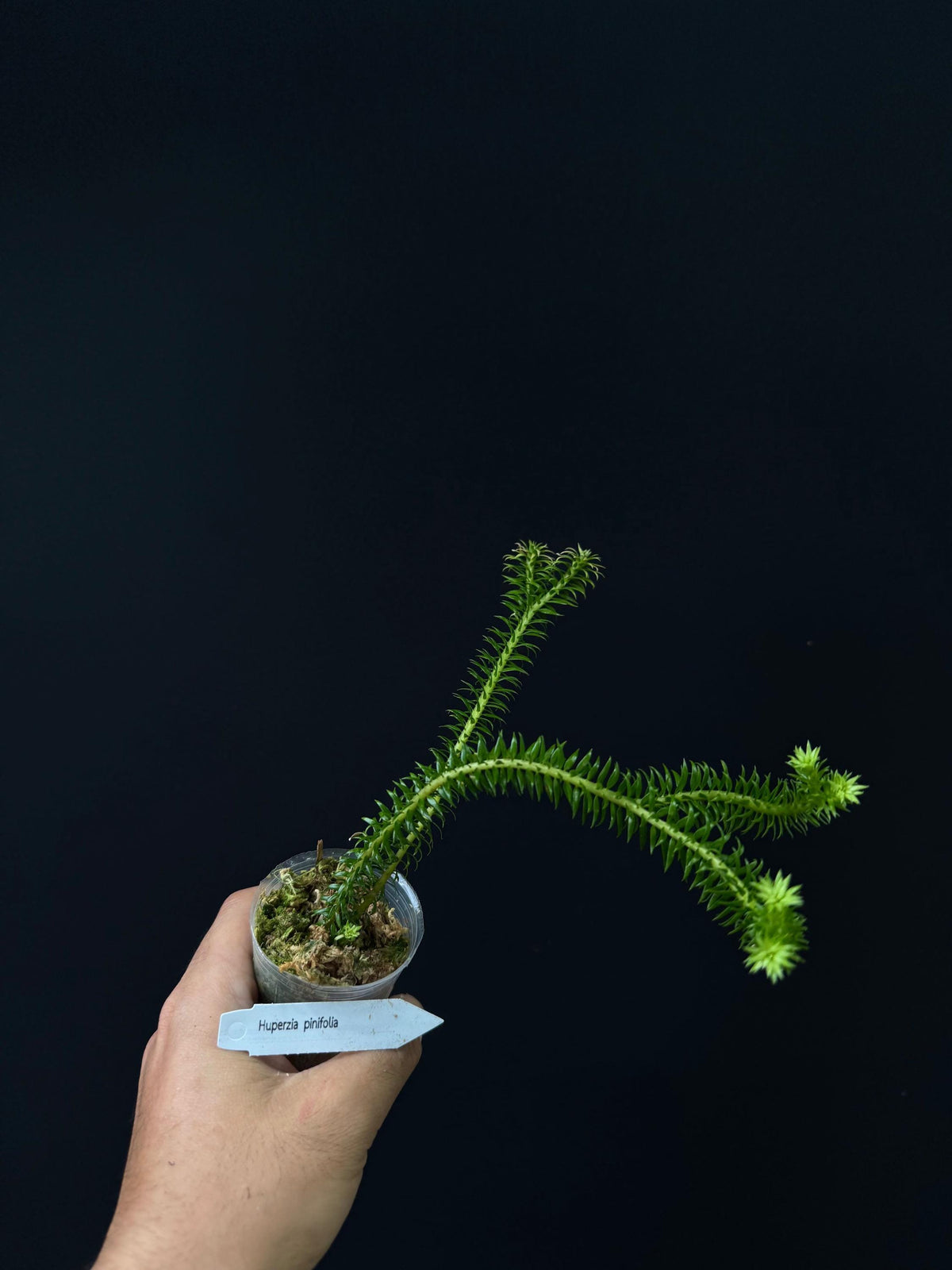
Huperzia pinifolia
Huperzia pinifolia
Huperzia pinifolia is a distinctive tropical clubmoss known for its dense, narrow foliage and cascading epiphytic growth. The leaves are noticeably longer and narrower than those of many Huperzia, giving the stems a clean, almost miniature conifer-like appearance.
As the plant matures, the stems branch repeatedly and eventually hang downward, creating a dense curtain of green growth. Its structured foliage and naturally pendulous habit make it especially attractive in hanging baskets or mounted displays.
Foliage
The foliage is one of the easiest ways to recognize Huperzia pinifolia.
Leaves are narrow and linear to lance-shaped, densely covering the stems and extending outward rather than lying flat against them.
This creates a full, bristled appearance reminiscent of pine or fir foliage, which is reflected in the name pinifolia.
The leaves are generally:
Narrow and elongated
Bright to medium green
Firmly arranged around the stem
Dense along healthy established growth
Mature stems maintain this organized appearance even as they become longer and begin cascading.
Growth Habit
Huperzia pinifolia is naturally epiphytic, meaning it grows attached to trees and other surfaces rather than rooted in dense ground soil.
Young growth may initially remain somewhat upright or arching, but stems become increasingly pendulous as they gain length.
Mature plants develop branching stems that hang freely from the crown.
Allowing the plant to grow from an elevated position helps show off its natural form and prevents the stems from becoming bent or compressed.
A hanging basket is especially well suited for mature specimens.
Light
Provide bright indirect or filtered light.
Huperzia pinifolia naturally grows in wet tropical environments where it receives plenty of light filtered through surrounding vegetation.
Good growing locations include:
Bright indirect indoor light
Filtered greenhouse light
Bright outdoor shade
Gentle morning sun
Avoid prolonged intense afternoon sun, especially during hot weather.
Too much direct sun can cause pale foliage, yellowing, or crispy tips.
Very low light can produce weaker, more stretched growth.
Water
Keep the root zone consistently moist without keeping it waterlogged.
Water thoroughly whenever the growing media begins to approach dryness.
Huperzia pinifolia should not be allowed to remain completely dry for extended periods.
At the same time, the fine epiphytic roots require oxygen, so constantly saturated and compacted media should be avoided.
The ideal watering cycle is:
Water thoroughly
Allow some moisture to evaporate
Water again before the root zone becomes completely dry
Mounted plants may require considerably more frequent watering than plants grown in baskets or pots.
Always adjust watering frequency based on temperature, humidity, airflow, and the type of growing media being used.
Humidity
Huperzia pinifolia appreciates high humidity, particularly while producing new growth.
Approximately 65–85% humidity provides excellent conditions.
Consistent humidity encourages lush foliage and helps prevent the narrow leaves from developing dry tips.
Established plants may adapt to somewhat lower humidity when watering is consistent, but prolonged dry air can slow growth and cause browning.
High humidity should always be paired with good airflow.
Airflow
Provide consistent gentle airflow around the plant.
Moving air is especially important when growing Huperzia under warm, humid conditions.
Good airflow helps:
Prevent stagnant moisture around the crown
Allow the growing media to breathe
Reduce the chance of staying excessively wet
Encourage healthy epiphytic root growth
Avoid placing the plant in enclosed areas where both the foliage and root zone remain constantly wet with little air movement.
Temperature
Ideal temperatures are approximately 65–82°F.
Warm and relatively stable temperatures encourage steady growth.
Protect from extended temperatures below approximately 55°F.
Huperzia pinifolia is a tropical plant and should be protected from frost and freezing temperatures.
During cooler periods, growth may slow and the growing media will remain moist longer, so watering frequency should be reduced accordingly.
Growing Media
Use a loose, airy, moisture-retentive epiphytic mix.
Long-fiber sphagnum moss works especially well.
Other suitable mixtures may include:
Long-fiber sphagnum
Fine orchid bark
Perlite
Tree fern fiber
A combination of sphagnum and fine bark
The goal is to create a root environment that remains evenly moist while still containing plenty of air.
Avoid dense standard potting soil or heavy mixes that stay saturated for long periods.
If using sphagnum, keep it relatively loose rather than packing it tightly around the roots.
Potting and Mounting
Huperzia pinifolia can be grown successfully in hanging pots, slatted baskets, net pots, or mounted arrangements.
Hanging baskets are particularly useful because they retain moisture while allowing the stems to cascade naturally.
Mounted plants can create a beautiful natural presentation but generally dry significantly faster.
When mounting, use a moisture-retentive material such as sphagnum around the root system.
Leave plenty of space below the plant so developing stems can hang without resting against shelves or other plants.
Growth
Huperzia pinifolia develops relatively short branching sections that repeatedly divide as the plant matures.
Healthy established growth becomes densely covered with narrow foliage, and repeated branching gradually creates a fuller specimen.
A newly transplanted plant may initially concentrate on establishing its root system before producing noticeably longer stems.
Once established, growth becomes more consistent under warm and humid conditions.
Avoid unnecessary repotting or repeatedly disturbing the root system.
Mature Form
Mature Huperzia pinifolia develops a distinctly cascading appearance.
The combination of narrow leaves and branching stems gives the plant a dense but refined texture compared with broader-leaved Huperzia.
Its foliage remains tightly arranged around the stems while the entire plant gradually develops into a hanging mass of growth.
Older specimens can become especially impressive when allowed to remain undisturbed and develop naturally.
Spore-Bearing Growth
Huperzia do not flower or produce seeds.
Instead, mature plants reproduce through spores.
Huperzia pinifolia develops distinctly differentiated spore-bearing portions toward mature stem growth.
The fertile sections may appear thinner and more structured than normal vegetative growth.
This is completely natural and is a sign that the plant has reached reproductive maturity.
Feeding
Feed lightly during periods of active growth.
A balanced fertilizer diluted to approximately ¼ strength can be applied periodically during watering.
Huperzia generally respond better to weak, consistent feeding than strong fertilizer applications.
Avoid allowing concentrated fertilizer salts to accumulate around the roots.
Occasionally flush the growing media thoroughly with plain water.
Reduce feeding during cooler periods or whenever active growth slows.
Water Quality
Rainwater, reverse-osmosis water, distilled water, or other low-mineral water is ideal when available.
Plants grown in sphagnum can gradually accumulate minerals and fertilizer salts because the moss holds moisture for extended periods.
If using tap water, periodically flush the growing media thoroughly to help remove accumulated minerals.
Best Growing Conditions
Bright filtered light
65–85% humidity
65–82°F temperatures
Consistent gentle airflow
Even moisture without waterlogged roots
Loose sphagnum or another airy epiphytic mix
Hanging placement with room for cascading stems
Light fertilizer during active growth
Additional Notes
Huperzia pinifolia is naturally found across a wide portion of tropical Asia and the western Pacific, including Sri Lanka, Thailand, Malaysia, Indonesia, the Philippines, New Guinea, the Solomon Islands, and Vanuatu.
It is naturally an epiphyte of wet tropical environments, which explains its preference for high humidity, consistent moisture, excellent drainage, and an airy root zone.
The species is especially recognizable by its long, narrow foliage held outward from the stems and its clearly defined fertile growth.
Give Huperzia pinifolia plenty of vertical room as it matures. The plant becomes increasingly attractive as the stems lengthen, branch, and develop into a dense hanging specimen.
-------
⚠️ Important Shipping Notes
We take great care to ensure your plant arrives safely:
• We ship every Monday and Tuesday to minimize weekend delays.
• We check destination weather on Sunday night and will add free insulation and heat packs when needed for safe delivery.
• If a plant arrives damaged, buyers must provide an unboxing video within one hour of delivery.
(We cannot be responsible for plants left outside, delayed opening, or packages exposed to heat/cold.)
🌟 Perfect For:
• Rare plant collectors
• Fans of unusual foliage
• Terrarium or greenhouse keepers
• Anyone building a unique indoor jungle
Exported By ExportYourStore
Listed with ExportYourStore.com
Huperzia pinifolia is a distinctive tropical clubmoss known for its dense, narrow foliage and cascading epiphytic growth. The leaves are noticeably longer and narrower than those of many Huperzia, giving the stems a clean, almost miniature conifer-like appearance.
As the plant matures, the stems branch repeatedly and eventually hang downward, creating a dense curtain of green growth. Its structured foliage and naturally pendulous habit make it especially attractive in hanging baskets or mounted displays.
Foliage
The foliage is one of the easiest ways to recognize Huperzia pinifolia.
Leaves are narrow and linear to lance-shaped, densely covering the stems and extending outward rather than lying flat against them.
This creates a full, bristled appearance reminiscent of pine or fir foliage, which is reflected in the name pinifolia.
The leaves are generally:
Narrow and elongated
Bright to medium green
Firmly arranged around the stem
Dense along healthy established growth
Mature stems maintain this organized appearance even as they become longer and begin cascading.
Growth Habit
Huperzia pinifolia is naturally epiphytic, meaning it grows attached to trees and other surfaces rather than rooted in dense ground soil.
Young growth may initially remain somewhat upright or arching, but stems become increasingly pendulous as they gain length.
Mature plants develop branching stems that hang freely from the crown.
Allowing the plant to grow from an elevated position helps show off its natural form and prevents the stems from becoming bent or compressed.
A hanging basket is especially well suited for mature specimens.
Light
Provide bright indirect or filtered light.
Huperzia pinifolia naturally grows in wet tropical environments where it receives plenty of light filtered through surrounding vegetation.
Good growing locations include:
Bright indirect indoor light
Filtered greenhouse light
Bright outdoor shade
Gentle morning sun
Avoid prolonged intense afternoon sun, especially during hot weather.
Too much direct sun can cause pale foliage, yellowing, or crispy tips.
Very low light can produce weaker, more stretched growth.
Water
Keep the root zone consistently moist without keeping it waterlogged.
Water thoroughly whenever the growing media begins to approach dryness.
Huperzia pinifolia should not be allowed to remain completely dry for extended periods.
At the same time, the fine epiphytic roots require oxygen, so constantly saturated and compacted media should be avoided.
The ideal watering cycle is:
Water thoroughly
Allow some moisture to evaporate
Water again before the root zone becomes completely dry
Mounted plants may require considerably more frequent watering than plants grown in baskets or pots.
Always adjust watering frequency based on temperature, humidity, airflow, and the type of growing media being used.
Humidity
Huperzia pinifolia appreciates high humidity, particularly while producing new growth.
Approximately 65–85% humidity provides excellent conditions.
Consistent humidity encourages lush foliage and helps prevent the narrow leaves from developing dry tips.
Established plants may adapt to somewhat lower humidity when watering is consistent, but prolonged dry air can slow growth and cause browning.
High humidity should always be paired with good airflow.
Airflow
Provide consistent gentle airflow around the plant.
Moving air is especially important when growing Huperzia under warm, humid conditions.
Good airflow helps:
Prevent stagnant moisture around the crown
Allow the growing media to breathe
Reduce the chance of staying excessively wet
Encourage healthy epiphytic root growth
Avoid placing the plant in enclosed areas where both the foliage and root zone remain constantly wet with little air movement.
Temperature
Ideal temperatures are approximately 65–82°F.
Warm and relatively stable temperatures encourage steady growth.
Protect from extended temperatures below approximately 55°F.
Huperzia pinifolia is a tropical plant and should be protected from frost and freezing temperatures.
During cooler periods, growth may slow and the growing media will remain moist longer, so watering frequency should be reduced accordingly.
Growing Media
Use a loose, airy, moisture-retentive epiphytic mix.
Long-fiber sphagnum moss works especially well.
Other suitable mixtures may include:
Long-fiber sphagnum
Fine orchid bark
Perlite
Tree fern fiber
A combination of sphagnum and fine bark
The goal is to create a root environment that remains evenly moist while still containing plenty of air.
Avoid dense standard potting soil or heavy mixes that stay saturated for long periods.
If using sphagnum, keep it relatively loose rather than packing it tightly around the roots.
Potting and Mounting
Huperzia pinifolia can be grown successfully in hanging pots, slatted baskets, net pots, or mounted arrangements.
Hanging baskets are particularly useful because they retain moisture while allowing the stems to cascade naturally.
Mounted plants can create a beautiful natural presentation but generally dry significantly faster.
When mounting, use a moisture-retentive material such as sphagnum around the root system.
Leave plenty of space below the plant so developing stems can hang without resting against shelves or other plants.
Growth
Huperzia pinifolia develops relatively short branching sections that repeatedly divide as the plant matures.
Healthy established growth becomes densely covered with narrow foliage, and repeated branching gradually creates a fuller specimen.
A newly transplanted plant may initially concentrate on establishing its root system before producing noticeably longer stems.
Once established, growth becomes more consistent under warm and humid conditions.
Avoid unnecessary repotting or repeatedly disturbing the root system.
Mature Form
Mature Huperzia pinifolia develops a distinctly cascading appearance.
The combination of narrow leaves and branching stems gives the plant a dense but refined texture compared with broader-leaved Huperzia.
Its foliage remains tightly arranged around the stems while the entire plant gradually develops into a hanging mass of growth.
Older specimens can become especially impressive when allowed to remain undisturbed and develop naturally.
Spore-Bearing Growth
Huperzia do not flower or produce seeds.
Instead, mature plants reproduce through spores.
Huperzia pinifolia develops distinctly differentiated spore-bearing portions toward mature stem growth.
The fertile sections may appear thinner and more structured than normal vegetative growth.
This is completely natural and is a sign that the plant has reached reproductive maturity.
Feeding
Feed lightly during periods of active growth.
A balanced fertilizer diluted to approximately ¼ strength can be applied periodically during watering.
Huperzia generally respond better to weak, consistent feeding than strong fertilizer applications.
Avoid allowing concentrated fertilizer salts to accumulate around the roots.
Occasionally flush the growing media thoroughly with plain water.
Reduce feeding during cooler periods or whenever active growth slows.
Water Quality
Rainwater, reverse-osmosis water, distilled water, or other low-mineral water is ideal when available.
Plants grown in sphagnum can gradually accumulate minerals and fertilizer salts because the moss holds moisture for extended periods.
If using tap water, periodically flush the growing media thoroughly to help remove accumulated minerals.
Best Growing Conditions
Bright filtered light
65–85% humidity
65–82°F temperatures
Consistent gentle airflow
Even moisture without waterlogged roots
Loose sphagnum or another airy epiphytic mix
Hanging placement with room for cascading stems
Light fertilizer during active growth
Additional Notes
Huperzia pinifolia is naturally found across a wide portion of tropical Asia and the western Pacific, including Sri Lanka, Thailand, Malaysia, Indonesia, the Philippines, New Guinea, the Solomon Islands, and Vanuatu.
It is naturally an epiphyte of wet tropical environments, which explains its preference for high humidity, consistent moisture, excellent drainage, and an airy root zone.
The species is especially recognizable by its long, narrow foliage held outward from the stems and its clearly defined fertile growth.
Give Huperzia pinifolia plenty of vertical room as it matures. The plant becomes increasingly attractive as the stems lengthen, branch, and develop into a dense hanging specimen.
-------
⚠️ Important Shipping Notes
We take great care to ensure your plant arrives safely:
• We ship every Monday and Tuesday to minimize weekend delays.
• We check destination weather on Sunday night and will add free insulation and heat packs when needed for safe delivery.
• If a plant arrives damaged, buyers must provide an unboxing video within one hour of delivery.
(We cannot be responsible for plants left outside, delayed opening, or packages exposed to heat/cold.)
🌟 Perfect For:
• Rare plant collectors
• Fans of unusual foliage
• Terrarium or greenhouse keepers
• Anyone building a unique indoor jungle
Exported By ExportYourStore
Listed with ExportYourStore.com
Huperzia pinifolia
Sale price$49.00
Regular price (/)