Platycerium Ginka
Platycerium ‘Ginka’
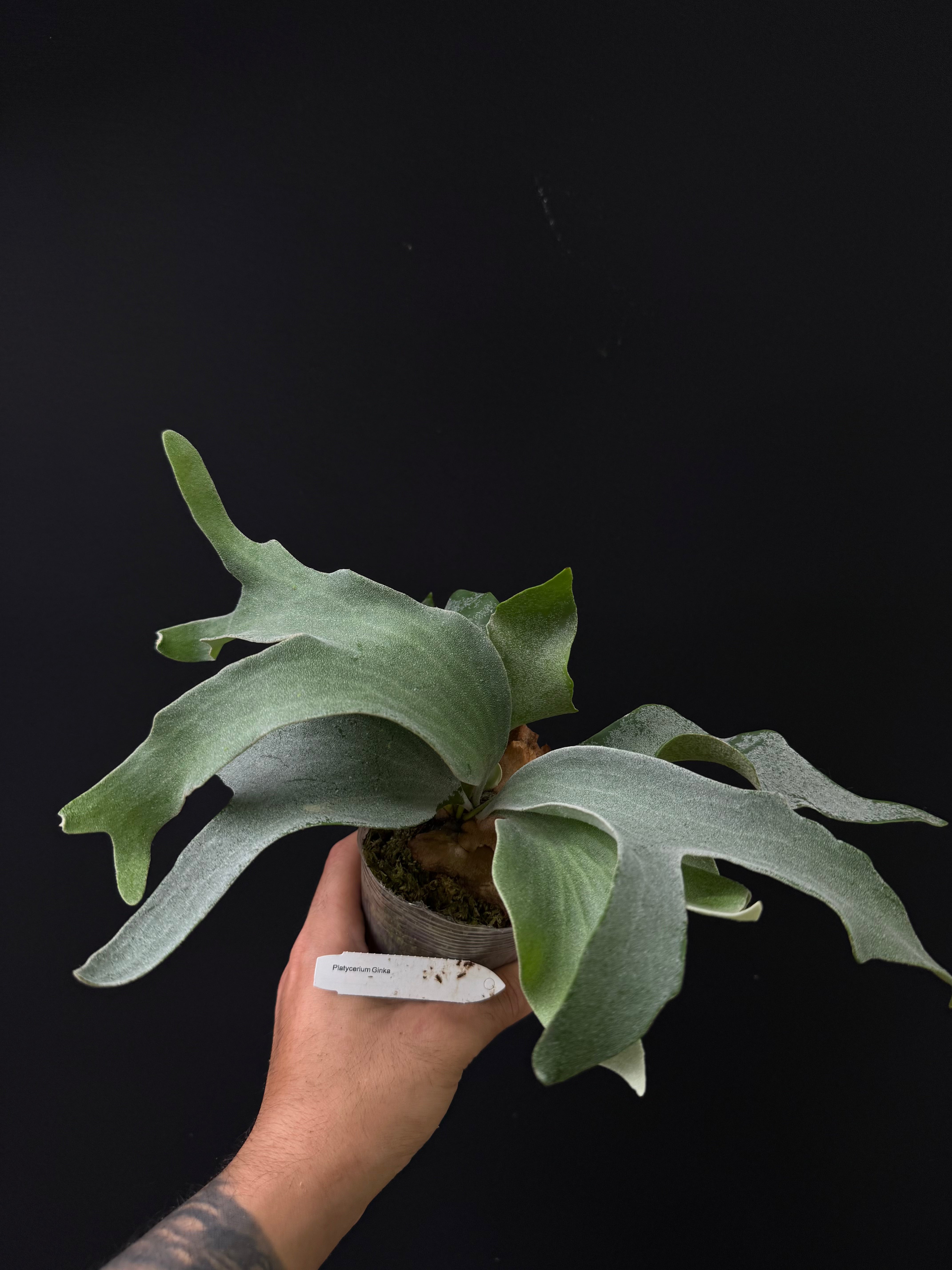
Platycerium ‘Ginka’ is a distinctive Thai cultivar selected from seedlings of Platycerium ‘Foong Si Qi’. It was selected for its unusually structured fertile fronds, thick foliage, silvery surface, and highly divided tips. The cultivar was selected and named by Thai breeder Wanna Pinjipaitoon.
As it matures, ‘Ginka’ develops a broad, sculptural appearance with fertile fronds spreading strongly to each side rather than simply hanging downward.
Shield Fronds
The shield fronds form a broad layered base around the growing point and mounting surface.
New shields emerge green and gradually develop more texture and character as they mature. Older shields naturally transition to tan and eventually brown.
These older shields should generally remain attached. They protect the root system, help retain moisture around the mount, and contribute to the characteristic layered appearance of a mature Platycerium.
The upper edges can develop irregular waves and divisions that become increasingly pronounced with age.
Fertile Fronds
The fertile fronds are the defining feature of ‘Ginka’.
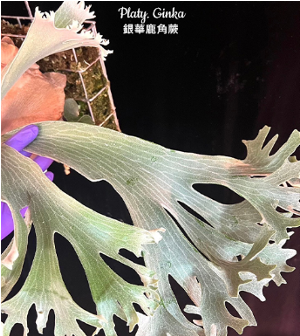
They develop thick, substantial growth and tend to spread outward toward both sides of the plant. Mature fronds develop numerous short divisions at their ends, producing an almost crested or snowflake-like branching pattern.
Unlike cultivars with extremely long, narrow trailing fronds, ‘Ginka’ develops a fuller and more structured silhouette.
Its mature fertile fronds can display irregular waves throughout the blade before terminating in clusters of finely divided tips.
Coloration
‘Ginka’ develops attractive silver-green foliage with visible pale trichomes across the surface.
These fine hairs create the frosted appearance of the fronds and help protect the plant from moisture loss and intense light.
Avoid wiping or rubbing the foliage because the trichomes can be permanently removed.
Plants grown under strong filtered light generally develop a brighter silver appearance and firmer growth.
Light
Provide bright filtered light to very bright indirect light.
‘Ginka’ benefits from plenty of light to maintain its compact structure, strong branching, and silver coloration.
Bright greenhouse conditions, bright outdoor shade, or gentle morning sun work especially well.
Avoid suddenly exposing a plant that has been grown under shade to intense direct afternoon sun.
Gradually acclimate the plant whenever increasing light levels.
Water
Water thoroughly and allow the mounting material to partially dry before watering again.
When mounted in sphagnum, soak the moss thoroughly enough that moisture reaches the entire root mass.
Allow the moss to become noticeably lighter before watering again rather than keeping it constantly saturated.
As the shield fronds begin enclosing the mount, the interior can remain moist considerably longer than the visible surface.
Always check the moisture within the mount rather than relying entirely on a watering schedule.
Humidity
Approximately 60–80% humidity provides excellent growing conditions.
‘Ginka’ appreciates humid air, particularly while producing new shields and fertile fronds.
It can adapt to somewhat lower humidity when watering and airflow are balanced properly.
Higher humidity should always be combined with good air movement.
Airflow
Consistent airflow is important.
Gentle moving air allows moisture around the foliage and mounting material to evaporate gradually while reducing stagnant conditions around the growing point.
The ideal balance is high humidity around the foliage without keeping the root system continuously wet.
Temperature
Ideal temperatures are approximately 68–85°F.
Warm, stable conditions encourage steady growth.
Protect from prolonged cold conditions, particularly temperatures below approximately 55–60°F.
Keep away from frost and freezing temperatures.
During cooler weather, allow additional drying time between waterings.
Growing Media
Long-fiber sphagnum moss works very well for mounted plants.
The moss should be moisture-retentive while remaining loose and airy.
Avoid tightly compressing large amounts of moss around the roots.
The goal is to provide consistent moisture while still allowing oxygen to reach the root system.
Mounting
‘Ginka’ is especially impressive when grown vertically on a mount where its broad fertile fronds can spread naturally.
Suitable mounting surfaces include wood boards, cork, tree fern panels, and moisture-resistant synthetic boards.
Leave adequate room around the plant when mounting a juvenile specimen because the shields can eventually cover a substantial portion of the board.
Keep the growing point upright and unobstructed.
Growth Habit
Moderate growing with a broad, highly structured mature form.
‘Ginka’ tends to spread strongly toward both sides as the fertile fronds develop, creating a balanced silhouette.
The combination of thick foliage, irregular waves, pale trichomes, and numerous short terminal divisions gives mature plants a particularly recognizable appearance.
The branching becomes increasingly dramatic as the plant gains maturity.
Feeding
Feed lightly during active growth.
A balanced fertilizer diluted to approximately ¼ strength can be applied periodically during watering.
Light, consistent feeding is preferable to occasional heavy fertilizer applications.
Reduce feeding during cooler periods or whenever active growth slows.
Avoid applying concentrated fertilizer directly to the growing point.
Pups
Established ‘Ginka’ plants may eventually produce pups around the base.
Pups can be left attached to create a larger multi-growth specimen or separated once they have developed several established fronds and their own root system.
Best Growing Conditions
Bright filtered light
60–80% humidity
68–85°F temperatures
Good consistent airflow
Thorough watering followed by partial drying
Loose long-fiber sphagnum moss
Minimal handling of the silver foliage
Additional Notes
‘Ginka’ was selected from approximately 500 spore-grown plants originating from ‘Foong Si Qi’, making its distinctive mature form the result of deliberate selection rather than simply another generic seedling.
Its most recognizable mature features are the broad outward-growing fertile fronds, thick texture, silvery trichomes, irregular waves, and densely divided tips.
Allow plenty of room around the plant as it matures so the fertile fronds can develop their full shape without being crowded.
--------
⚠️ Important Shipping Notes
We take great care to ensure your plant arrives safely:
• We ship every Monday and Tuesday to minimize weekend delays.
• We check destination weather on Sunday night and will add free insulation and heat packs when needed for safe delivery.
• If a plant arrives damaged, buyers must provide an unboxing video within one hour of delivery.
(We cannot be responsible for plants left outside, delayed opening, or packages exposed to heat/cold.)
🌟 Perfect For:
• Rare plant collectors
• Fans of architectural foliage
• Terrarium & vivarium setups
• Anyone building a unique indoor jungle